What Goes Inside a Technical Documentation Package?
Technical Documentation is the foundation of every EU MDR submission. It is the complete body of evidence that demonstrates your device meets the General Safety and Performance Requirements of Regulation (EU) 2017/745 — and it is what your Notified Body will scrutinize during conformity assessment.
Despite its importance, Technical Documentation is one of the most misunderstood deliverables in the MDR compliance process. Many manufacturers underestimate its scope, confuse it with the old MDD Technical File, or treat it as a one-time deliverable rather than a living document that must be maintained throughout the device lifecycle.
This article explains exactly what goes inside a Technical Documentation package under EU MDR, how it is structured, and what your Notified Body will expect to see.
Technical Documentation vs. Technical File — What Changed?
Under the old Medical Device Directive, manufacturers prepared a Technical File structured around MDD Annex II and III. While the basic concept was similar, the MDD Technical File requirements were significantly less prescriptive — leaving considerable room for interpretation and resulting in wide variation in quality across submissions.
EU MDR 2017/745 replaced the Technical File with Technical Documentation, structured according to MDR Annex II and Annex III. The new requirements are far more detailed, more specific, and more demanding — particularly in areas such as clinical evaluation, post-market surveillance, software, and the General Safety and Performance Requirements matrix.
If you have an existing MDD Technical File, it cannot simply be relabeled as MDR Technical Documentation. A structured gap analysis is essential before you begin your Notified Body review.
The Legal Framework
Technical Documentation requirements are defined in two annexes of EU MDR 2017/745.
Annex II covers Technical Documentation — the main body of evidence covering device description, design and manufacturing information, GSPRs, pre-clinical and clinical data, and post-market information.
Annex III covers Technical Documentation on Post-Market Surveillance — the PMS-specific documentation that must be maintained separately and updated regularly.
Together, these two annexes define the complete Technical Documentation package that manufacturers must compile, maintain, and make available to their Notified Body and competent authorities on request.
Part A — Device Description and Specification
The first section of Technical Documentation establishes what your device is and what it is intended to do. This sounds straightforward, but MDR Annex II §1.1 is significantly more detailed than the equivalent MDD requirement.
The device description must include the intended purpose of the device — what it does, for whom, and in what clinical context. This must be precise and unambiguous, because the intended purpose drives classification, clinical evidence requirements, and GSPR applicability.
It must also include the Basic UDI-DI and a complete list of all UDI-DIs for every device configuration covered by the Technical Documentation. This is a new requirement under MDR with no MDD equivalent.
The description must cover all variants, configurations, sizes, and accessories included in scope. It must list all materials in contact with the human body, with biocompatibility justification for each. And it must include technical specifications — dimensions, tolerances, mechanical properties, electrical specifications, and software version information where applicable.
Part B — Information Provided by the Manufacturer
This section covers all labelling and Instructions for Use associated with your device. MDR Annex I §23 defines specific requirements for the content and format of labelling — including mandatory symbols, the CE marking with Notified Body number, UDI carrier, manufacturer details, and all required warnings and contraindications.
The Instructions for Use must be provided in the official languages of all EU Member States where the device is placed on the market. Electronic IFU are permitted for certain device categories under Regulation (EU) No 207/2012, but specific conditions apply.
Draft labelling and IFU must be included in your Technical Documentation at the time of Notified Body review, even if final printed versions are not yet available. Any subsequent changes to labelling may require NB notification or re-assessment depending on the nature of the change.
Part C — Design and Manufacturing Information
This section documents how the device was designed and how it is manufactured. It includes the design history — the documented stages of design development from initial concept through verification, validation, and design transfer.
Manufacturing information must identify all sites involved in the design, manufacture, sterilization, and assembly of the device. For outsourced manufacturing or sterilization, the relationships and quality controls in place must be clearly described.
If the device is supplied sterile, the sterilization method must be described and validated. If the device contains software, the Software Development Lifecycle documentation must be included here, covering architecture, requirements, verification and validation, and risk management specific to the software.
Part D — General Safety and Performance Requirements
The GSPR section is often the most labor-intensive part of Technical Documentation — and the one most frequently criticized during Notified Body reviews.
MDR Annex I contains 23 sections of General Safety and Performance Requirements covering everything from general safety principles and risk management to chemical safety, biological safety, sterility, software, active devices, radiation protection, and labelling.
Your Technical Documentation must include a complete GSPR checklist — sometimes called a GSPR matrix — that maps every applicable requirement from Annex I to specific design features, test evidence, harmonized standards, or Common Specifications. For each requirement, you must state whether it is applicable to your device, and if so, how compliance is demonstrated.
Harmonized standards play a key role here. When you apply a harmonized standard — such as ISO 10993-1 for biocompatibility or IEC 60601-1 for electrical safety — you benefit from a presumption of conformity with the corresponding GSPR. Your Technical Documentation must list all standards applied, including version numbers and dates, and justify any deviations.
Part E — Benefit-Risk Analysis and Risk Management
Risk management documentation is required throughout the device lifecycle and must be integrated into your Technical Documentation in accordance with ISO 14971:2019.
The risk management section must include a Risk Management Plan covering scope, responsibilities, risk acceptability criteria, and review frequency. It must document the hazard identification process, risk estimation and evaluation, risk control measures and their verification, and residual risk assessment.
Critically, under MDR the benefit-risk determination must be explicitly documented. It is not sufficient to demonstrate that risks have been reduced — you must affirmatively conclude that the overall residual risk is acceptable given the clinical benefits the device provides. This conclusion must be consistent with the Clinical Evaluation Report.
The Risk Management Report summarizes the entire risk management process and its conclusions, and must be updated whenever new information from post-market activities affects the risk profile of the device.
Part F — Pre-Clinical Evaluation
This section contains all non-clinical evidence supporting the safety and performance of your device. It typically includes the following.
Biocompatibility evaluation per ISO 10993-1:2018, covering all patient-contacting materials. The evaluation must be risk-based and include chemical characterization of materials, with biological testing conducted only where material data is insufficient to draw conclusions.
Bench and performance testing demonstrating that the device meets its technical specifications under simulated use conditions. Test protocols, acceptance criteria, and results must all be documented.
Software verification and validation for devices containing software, including the complete Software Development Lifecycle documentation per IEC 62304 and cybersecurity assessment per relevant FDA and MDCG guidance.
Electrical safety and EMC testing for active devices per the IEC 60601 series.
Usability engineering documentation per IEC 62366-1, including use-related risk analysis and summative usability study results.
Shelf life and packaging validation for devices with a defined shelf life or sterile packaging, per ISO 11607.
Part G — Clinical Evaluation
The clinical evaluation section is one of the most significant additions to MDR Technical Documentation compared to MDD Technical Files — and one of the most commonly deficient areas in NB reviews.
Under MDR Annex XIV, the clinical evaluation must include a Clinical Evaluation Plan documenting the scope, methodology, and data sources to be used. It must include a documented systematic literature search with defined search strategy, inclusion and exclusion criteria, and appraisal methodology. And it must culminate in a Clinical Evaluation Report that summarizes all clinical evidence, draws conclusions about safety and performance, and makes an explicit benefit-risk determination.
The CER is not a one-time document. It must be updated as part of the Post-Market Surveillance cycle — annually for Class III and IIb devices, and at defined intervals for lower-risk classes.
For Class IIb and III devices where equivalence to another manufacturer’s device is claimed, MDR requires contractual access to that device’s Technical Documentation. Without this access, the equivalence route is effectively unavailable, and manufacturers must generate their own clinical data.
Part H — Post-Market Surveillance Documentation
Post-market documentation is covered in MDR Annex III and must be maintained as a separate but integrated part of your overall Technical Documentation.
The Post-Market Surveillance Plan must define the data sources to be monitored — including complaint data, literature, registries, social media, and field safety information — along with collection methods, analysis thresholds, and update frequency.
Class I devices require a Post-Market Surveillance Report summarizing PMS findings and any actions taken. Class IIa, IIb, and III devices require a Periodic Safety Update Report — submitted annually for Class III and IIb, and every two to five years for Class IIa.
For most Class IIa, IIb, and III devices, a Post-Market Clinical Follow-up Plan must also be included, along with PMCF Reports once data collection is underway. The PMCF Plan must define specific objectives, methods, and timelines for collecting clinical data after the device is placed on the market.
Part I — Additional Documentation for Special Device Types
Certain device types require additional documentation beyond the standard Annex II and III content.
Devices incorporating a medicinal substance as an integral part must include full characterization of the substance and documentation of the consultation with the European Medicines Agency or relevant national competent authority.
Devices incorporating materials of biological origin — including tissues or cells of human or animal origin — must include a specific risk assessment addressing TSE and BSE risks and compliance with Regulation (EU) 722/2012.
Devices incorporating nanomaterials must include specific safety characterization per MDR Annex I §10.4, addressing the physicochemical properties, potential for internal exposure, and toxicological profile of the nanomaterial.
How Technical Documentation Must Be Maintained
One of the most important shifts introduced by MDR is that Technical Documentation is a living document, not a static submission package.
Manufacturers must have a documented process for reviewing and updating their Technical Documentation in response to post-market surveillance findings, PMCF data, updated clinical evaluations, changes to harmonized standards, regulatory guidance updates, and design or manufacturing changes.
Any significant change to the device — in design, materials, intended use, manufacturing process, or labelling — must be assessed against the existing Technical Documentation and may require Notified Body notification or re-assessment under Annex IX Chapter III.
Failure to maintain Technical Documentation is one of the most common findings in NB surveillance audits and competent authority inspections.
Where to Go From Here
Building Technical Documentation from scratch is a significant undertaking — but having a structured framework makes the process manageable.
Our EU MDR Registration Guide gives your team a complete, structured workbook covering all sections of MDR Technical Documentation — from device description and GSPR matrix through clinical evaluation, post-market surveillance, and project timeline. It includes a 49-item MDR checklist with regulatory references for every requirement, a live progress dashboard, and a complete MDD to MDR gap analysis to identify what your existing Technical File is missing.
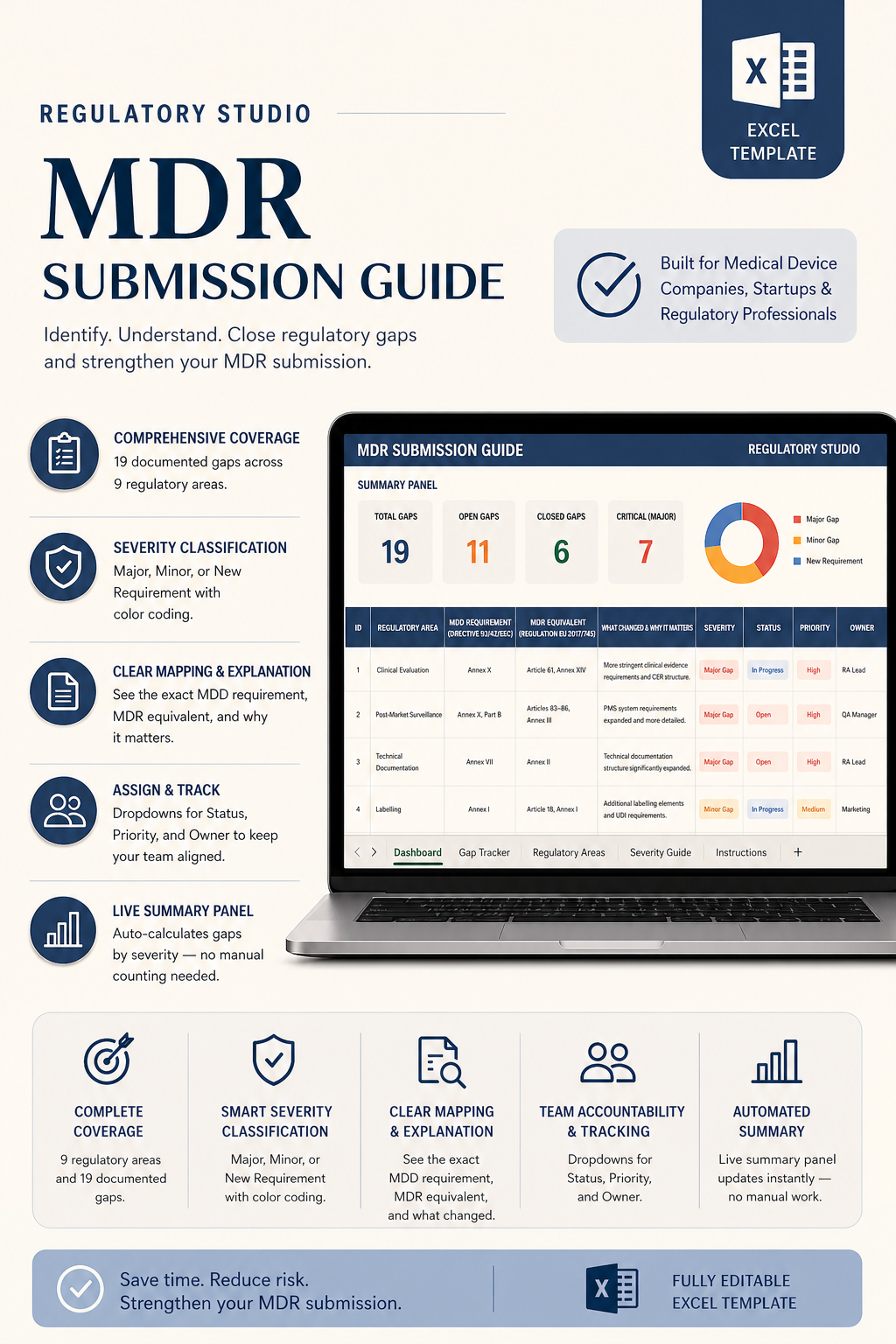
MDD to MDR Gap Analysis — Know Exactly What's Missing Before Your Notified Body Does
Transitioning from the Medical Device Directive to EU MDR 2017/745 is not just an update — it's a complete overhaul of how your Technical Documentation needs to be structured, evidenced, and maintained.
Most companies don't discover their gaps until they're already in front of a Notified Body. That's expensive. That's avoidable.
The MDD to MDR Gap Analysis is a professional Excel tool that maps every critical difference between Directive 93/42/EEC and Regulation (EU) 2017/745 — so your team knows exactly what needs to be done, in what order, and who owns it.
What's inside:
19 documented gaps across 9 regulatory areas — including Clinical Evaluation, Post-Market Surveillance, Technical Documentation, Labelling, UDI, EUDAMED, Software, Risk Management, and Notified Body certification.
Every gap is classified by severity — Major Gap, Minor Gap, or New Requirement — with color coding so you can prioritize at a glance.
Each row includes the exact MDD requirement, the MDR equivalent, and a clear explanation of what changed and why it matters for your submission.
Built-in dropdowns for Status, Priority, and Owner so your team can assign accountability and track progress in real time.
A live Summary Panel that auto-calculates how many gaps are open, closed, and critical — no manual counting needed.
